URL Input
Renders <input type="url">. The browser provides built-in URL format validation. Default sanitizer: Sanitize::TEXT.
Class: PinkCrab\Form_Components\Element\Field\Input\Url
Make helper: Make::url( 'name', fn(Url $f) => $f->... )
Basic Usage
$this->component( new Input_Component(
        Url::make( 'website' )
            ->label( 'Website' )
            ->placeholder( 'https://example.com' )
    ) )
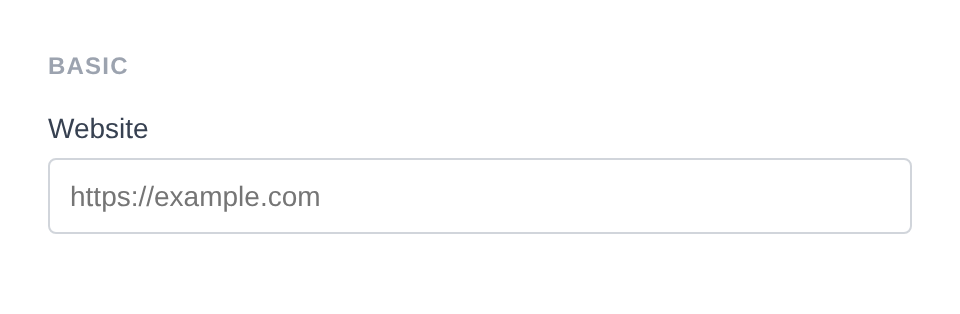
Generated HTML
<div id="form-field_website" class="pc-form__element pc-form__element--url_input">
    <label for="website" class="pc-form__label">Website</label>
        <input type="url" name="website" class="form-control url-input pc-form__element__field pc-form__element__field--url_input" list="_website__list" placeholder="https://example.com" />
    </div>
Using Make Helper
use PinkCrab\Form_Components\Util\Make;

$this->component( Make::url( 'website', fn( $f ) => $f
    ->label( 'Website' )
    ->placeholder( 'https://example.com' )
) );
Methods
label( string $label )
Sets the visible label text above the input.
Url::make( 'website' )->label( 'Website' )
Generated HTML
<div id="form-field_website" class="pc-form__element pc-form__element--url_input">
    <label for="website" class="pc-form__label">Website</label>
    <input type="url" name="website"
        class="form-control url-input pc-form__element__field pc-form__element__field--url_input"
    />
</div>
set_existing( mixed $value )
Sets the current value. Runs through the sanitizer if one is set.
Url::make( 'website' )
    ->label( 'Website' )
    ->set_existing( 'https://example.com' )
Generated HTML
<div id="form-field_website" class="pc-form__element pc-form__element--url_input">
    <label for="website" class="pc-form__label">Website</label>
    <input type="url" name="website"
        class="form-control url-input pc-form__element__field pc-form__element__field--url_input"
        value="https://example.com"
    />
</div>
placeholder( string $text )
Placeholder text shown when the field is empty.
Url::make( 'website' )
    ->label( 'Website' )
    ->placeholder( 'https://example.com' )
Generated HTML
<div id="form-field_website" class="pc-form__element pc-form__element--url_input">
    <label for="website" class="pc-form__label">Website</label>
    <input type="url" name="website"
        class="form-control url-input pc-form__element__field pc-form__element__field--url_input"
        placeholder="https://example.com"
    />
</div>
required( bool $required = true )
Marks the field as required. The label displays a * indicator via CSS.
Url::make( 'website' )
    ->label( 'Website' )
    ->required( true )
Generated HTML
<div id="form-field_website" class="pc-form__element pc-form__element--url_input">
    <label for="website" class="pc-form__label">Website</label>
    <input type="url" name="website"
        class="form-control url-input pc-form__element__field pc-form__element__field--url_input"
        required=""
    />
</div>
disabled( bool $disabled = true )
Disables the input. Value is visible but cannot be changed or submitted.
Url::make( 'locked_url' )
    ->label( 'Website' )
    ->set_existing( 'https://example.com' )
    ->disabled( true )
Generated HTML
<div id="form-field_locked_url" class="pc-form__element pc-form__element--url_input">
    <label for="locked_url" class="pc-form__label">Website</label>
    <input type="url" name="locked_url"
        class="form-control url-input pc-form__element__field pc-form__element__field--url_input"
        disabled="" value="https://example.com"
    />
</div>
readonly( bool $readonly = true )
Makes the field read-only. Value can be selected and copied but not changed.
Url::make( 'readonly_url' )
    ->label( 'Website' )
    ->set_existing( 'https://example.com' )
    ->readonly( true )
Generated HTML
<div id="form-field_readonly_url" class="pc-form__element pc-form__element--url_input">
    <label for="readonly_url" class="pc-form__label">Website</label>
    <input type="url" name="readonly_url"
        class="form-control url-input pc-form__element__field pc-form__element__field--url_input"
        readonly="" value="https://example.com"
    />
</div>
pattern( string $regex )
HTML5 validation pattern (regex) the value must match.
Url::make( 'website' )
    ->label( 'Website' )
    ->pattern( 'https://.*' )
    ->placeholder( 'Must start with https://' )
Generated HTML
<div id="form-field_website" class="pc-form__element pc-form__element--url_input">
    <label for="website" class="pc-form__label">Website</label>
    <input type="url" name="website"
        class="form-control url-input pc-form__element__field pc-form__element__field--url_input"
        pattern="https://.*" placeholder="Must start with https://"
    />
</div>
minlength( int $min ) / maxlength( int $max )
Minimum and maximum character length constraints.
Url::make( 'website' )
    ->label( 'Website' )
    ->minlength( 10 )
    ->maxlength( 255 )
Generated HTML
<div id="form-field_website" class="pc-form__element pc-form__element--url_input">
    <label for="website" class="pc-form__label">Website</label>
    <input type="url" name="website"
        class="form-control url-input pc-form__element__field pc-form__element__field--url_input"
        minlength="10" maxlength="255"
    />
</div>
size( int $size )
Visible width of the input in characters.
Url::make( 'website' )
    ->label( 'Website' )
    ->size( 40 )
Generated HTML
<div id="form-field_website" class="pc-form__element pc-form__element--url_input">
    <label for="website" class="pc-form__label">Website</label>
    <input type="url" name="website"
        class="form-control url-input pc-form__element__field pc-form__element__field--url_input"
        size="40"
    />
</div>
autocomplete( string $value )
HTML autocomplete attribute to help browsers autofill.
Url::make( 'website' )
    ->label( 'Website' )
    ->autocomplete( 'url' )
Generated HTML
<div id="form-field_website" class="pc-form__element pc-form__element--url_input">
    <label for="website" class="pc-form__label">Website</label>
    <input type="url" name="website"
        class="form-control url-input pc-form__element__field pc-form__element__field--url_input"
        autocomplete="url"
    />
</div>
Common values:
| Value | Description |
|---|---|
off | Disable autocomplete |
on | Enable autocomplete (browser decides) |
name | Full name |
given-name | First name |
family-name | Last name |
email | Email address |
username | Username |
new-password | New password (password managers) |
current-password | Current password |
organization | Company/organisation name |
street-address | Street address |
address-line1 | Address line 1 |
address-line2 | Address line 2 |
address-level2 | City |
address-level1 | State/province/region |
country | Country code |
country-name | Country name |
postal-code | Postcode / ZIP |
tel | Full phone number |
tel-national | Phone without country code |
url | URL |
bday | Full date of birth |
bday-day | Day of birth |
bday-month | Month of birth |
bday-year | Year of birth |
sex | Gender |
cc-name | Cardholder name |
cc-number | Card number |
cc-exp | Card expiry |
cc-csc | Card security code |
inputmode( string $mode )
Hints to mobile browsers which keyboard to display.
Url::make( 'website' )
    ->label( 'Website' )
    ->inputmode( 'url' )
Generated HTML
<div id="form-field_website" class="pc-form__element pc-form__element--url_input">
    <label for="website" class="pc-form__label">Website</label>
    <input type="url" name="website"
        class="form-control url-input pc-form__element__field pc-form__element__field--url_input"
        inputmode="url"
    />
</div>
Valid values:
| Value | Keyboard |
|---|---|
none | No virtual keyboard |
text | Standard text keyboard (default) |
decimal | Numbers with decimal point |
numeric | Numbers only |
tel | Telephone keypad |
search | Search-optimised keyboard |
email | Email-optimised keyboard |
url | URL-optimised keyboard |
spellcheck( string $value )
Enables or disables browser spell checking.
Url::make( 'website' )
    ->label( 'Website' )
    ->spellcheck( 'false' )
Generated HTML
<div id="form-field_website" class="pc-form__element pc-form__element--url_input">
    <label for="website" class="pc-form__label">Website</label>
    <input type="url" name="website"
        class="form-control url-input pc-form__element__field pc-form__element__field--url_input"
        spellcheck="false"
    />
</div>
datalist_items( array $items )
Autocomplete suggestions via an HTML <datalist> element.
Url::make( 'website' )
    ->label( 'Website' )
    ->datalist_items( array( 'https://google.com', 'https://github.com', 'https://wordpress.org' ) )
Generated HTML
<div id="form-field_website" class="pc-form__element pc-form__element--url_input">
    <label for="website" class="pc-form__label">Website</label>
    <input type="url" name="website"
        class="form-control url-input pc-form__element__field pc-form__element__field--url_input"
        list="_website__list"
    />
    <datalist id="_website__list">
        <option value="https://google.com"></option>
        <option value="https://github.com"></option>
        <option value="https://wordpress.org"></option>
    </datalist>
</div>
error_notification( string $message )
Displays an error message below the field.
Url::make( 'url_error' )
    ->label( 'Website' )
    ->required( true )
    ->error_notification( 'A valid URL is required.' )
Generated HTML
<div id="form-field_url_error" class="pc-form__element pc-form__element--url_input notification-error">
    <label for="url_error" class="pc-form__label">Website</label>
    <input type="url" name="url_error"
        class="form-control url-input pc-form__element__field pc-form__element__field--url_input notification-error"
        required=""
    />
    <div class="pc-form__notification pc-form__notification--error">A valid URL is required.</div>
</div>
warning_notification( string $message )
Displays a warning message below the field.
Url::make( 'url_warning' )
    ->label( 'Website' )
    ->set_existing( 'http://example.com' )
    ->warning_notification( 'URL does not use HTTPS.' )
Generated HTML
<div id="form-field_url_warning" class="pc-form__element pc-form__element--url_input notification-warning">
    <label for="url_warning" class="pc-form__label">Website</label>
    <input type="url" name="url_warning"
        class="form-control url-input pc-form__element__field pc-form__element__field--url_input notification-warning"
        value="http://example.com"
    />
    <div class="pc-form__notification pc-form__notification--warning">URL does not use HTTPS.</div>
</div>
success_notification( string $message )
Displays a success message below the field.
Url::make( 'url_success' )
    ->label( 'Website' )
    ->set_existing( 'https://example.com' )
    ->success_notification( 'URL is valid and reachable.' )
Generated HTML
<div id="form-field_url_success" class="pc-form__element pc-form__element--url_input notification-success">
    <label for="url_success" class="pc-form__label">Website</label>
    <input type="url" name="url_success"
        class="form-control url-input pc-form__element__field pc-form__element__field--url_input notification-success"
        value="https://example.com"
    />
    <div class="pc-form__notification pc-form__notification--success">URL is valid and reachable.</div>
</div>
info_notification( string $message )
Displays an info message below the field.
Url::make( 'url_info' )
    ->label( 'Website' )
    ->info_notification( 'Must include the protocol (https://).' )
Generated HTML
<div id="form-field_url_info" class="pc-form__element pc-form__element--url_input notification-info">
    <label for="url_info" class="pc-form__label">Website</label>
    <input type="url" name="url_info"
        class="form-control url-input pc-form__element__field pc-form__element__field--url_input notification-info"
    />
    <div class="pc-form__notification pc-form__notification--info">Must include the protocol (https://).</div>
</div>
pre_description( string $description )
Sets a description or hint displayed before the input.
Url::make( 'website' )
    ->label( 'Website' )
    ->pre_description( 'Your public profile URL.' )
post_description( string $description )
Sets a description or help text displayed after the input, before any notification.
Url::make( 'website' )
    ->label( 'Website' )
    ->post_description( 'Must start with https://' )
before( string $html ) / after( string $html )
HTML content before or after the input; renders whether or not the wrapper is shown.
Url::make( 'wrapped_url' )
    ->label( 'Website' )
    ->before( '<span style="color:#6b7280;font-size:13px;">Your public profile URL</span>' )
    ->after( '<span style="color:#6b7280;font-size:13px;">Must start with https://</span>' )
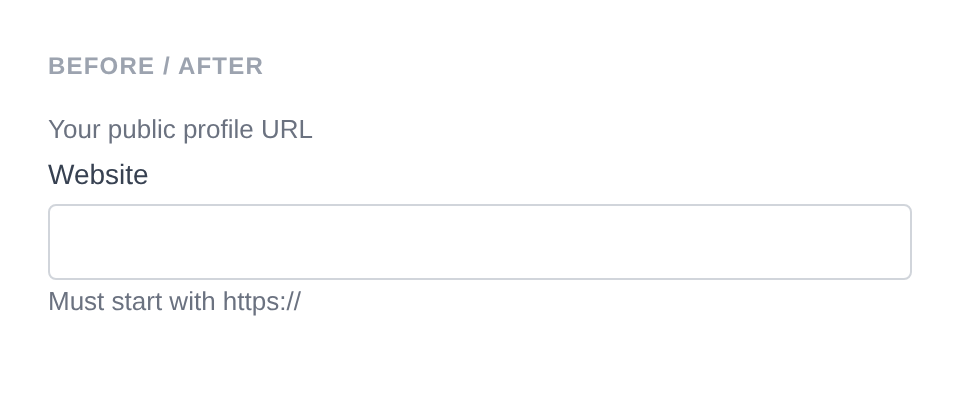
Generated HTML
<div id="form-field_wrapped_url" class="pc-form__element pc-form__element--url_input">
    <span style="color:#6b7280;font-size:13px">Your public profile URL</span>
        <label for="wrapped_url" class="pc-form__label">Website</label>
            <input type="url" name="wrapped_url" class="form-control url-input pc-form__element__field pc-form__element__field--url_input" list="_wrapped_url__list" />
            <span style="color:#6b7280;font-size:13px">Must start with https://</span>
            </div>
id( string $id )
Sets a custom HTML id on the input element.
Url::make( 'website' )
    ->id( 'my-custom-url-id' )
Generated HTML
<div id="form-field_website" class="pc-form__element pc-form__element--url_input">
    <input type="url" name="website" id="my-custom-url-id"
        class="form-control url-input pc-form__element__field pc-form__element__field--url_input"
    />
</div>
wrapper_id( string $id )
Sets a custom HTML id on the wrapper div.
Url::make( 'website' )
    ->wrapper_id( 'my-custom-wrapper-id' )
Generated HTML
<div id="my-custom-wrapper-id" class="pc-form__element pc-form__element--url_input">
    <input type="url" name="website"
        class="form-control url-input pc-form__element__field pc-form__element__field--url_input"
    />
</div>
data( string $key, string $value )
Adds a data-* attribute to the input.
Url::make( 'website' )
    ->data( 'validate', 'url' )
Generated HTML
<div id="form-field_website" class="pc-form__element pc-form__element--url_input">
    <input type="url" name="website"
        class="form-control url-input pc-form__element__field pc-form__element__field--url_input"
        data-validate="url"
    />
</div>
wrapper_data( string $key, string $value )
Adds a data-* attribute to the wrapper div.
Url::make( 'website' )
    ->wrapper_data( 'section', 'links' )
Generated HTML
<div id="form-field_website" class="pc-form__element pc-form__element--url_input" data-section="links">
    <input type="url" name="website"
        class="form-control url-input pc-form__element__field pc-form__element__field--url_input"
    />
</div>
add_class( string $class )
Adds a CSS class to the input element.
Url::make( 'website' )
    ->add_class( 'my-input-class' )
Generated HTML
<div id="form-field_website" class="pc-form__element pc-form__element--url_input">
    <input type="url" name="website"
        class="form-control url-input pc-form__element__field pc-form__element__field--url_input my-input-class"
    />
</div>
add_wrapper_class( string $class )
Adds a CSS class to the wrapper div.
Url::make( 'website' )
    ->add_wrapper_class( 'my-wrapper-class' )
Generated HTML
<div id="form-field_website" class="pc-form__element pc-form__element--url_input my-wrapper-class">
    <input type="url" name="website"
        class="form-control url-input pc-form__element__field pc-form__element__field--url_input"
    />
</div>
show_wrapper( bool $show = true )
Controls whether the wrapping <div> is rendered.
Url::make( 'bare' )
    ->show_wrapper( false )
Generated HTML
<input type="url" name="bare"
    class="form-control url-input pc-form__element__field pc-form__element__field--url_input"
/>
tabindex( int $index )
Sets the tab order of the input.
Url::make( 'website' )
    ->tabindex( 5 )
Generated HTML
<div id="form-field_website" class="pc-form__element pc-form__element--url_input">
    <input type="url" name="website"
        class="form-control url-input pc-form__element__field pc-form__element__field--url_input"
        tabindex="5"
    />
</div>
attribute( string $key, mixed $value )
Sets an arbitrary HTML attribute on the input.
Url::make( 'website' )
    ->attribute( 'aria-label', 'Enter your website URL' )
Generated HTML
<div id="form-field_website" class="pc-form__element pc-form__element--url_input">
    <input type="url" name="website"
        class="form-control url-input pc-form__element__field pc-form__element__field--url_input"
        aria-label="Enter your website URL"
    />
</div>
attributes( array $attrs )
Sets multiple arbitrary HTML attributes at once.
Url::make( 'website' )
    ->attributes( array(
        'title'    => 'Enter website URL',
        'tabindex' => '5',
    ) )
Generated HTML
<div id="form-field_website" class="pc-form__element pc-form__element--url_input">
    <input type="url" name="website"
        class="form-control url-input pc-form__element__field pc-form__element__field--url_input"
        title="Enter website URL" tabindex="5"
    />
</div>
sanitizer( callable $fn )
Sets a sanitization callback applied when set_existing() is called. Default: Sanitize::TEXT. Accepts any callable - a built-in helper constant, a WordPress function name, a closure, or any invokable.
Using a built-in helper:
use PinkCrab\Form_Components\Util\Sanitize;

Url::make( 'website' )
    ->sanitizer( Sanitize::URL )
    ->set_existing( 'https://example.com/path?q=1' )
Using a custom callable:
Url::make( 'website' )
    ->sanitizer( function( $value ) {
        return esc_url_raw( trim( $value ) );
    } )
    ->set_existing( '  https://example.com  ' ) // Stores: "https://example.com"
Using a WordPress function:
Url::make( 'website' )
    ->sanitizer( 'esc_url_raw' )
    ->set_existing( $user_input )
Built-in sanitizer helpers:
| Constant | Function | Description |
|---|---|---|
Sanitize::TEXT | sanitize_text_field() | Strips tags, removes extra whitespace |
Sanitize::TEXTAREA | sanitize_textarea_field() | Like TEXT but preserves line breaks |
Sanitize::URL | esc_url_raw() | Sanitises a URL for database storage |
Sanitize::EMAIL | sanitize_email() | Strips invalid email characters |
Sanitize::HEX_COLOR | sanitize_hex_color() | Validates hex colour (#fff or #ffffff) |
Sanitize::NUMBER | Custom numeric parser | Parses to int or float |
Sanitize::NOOP | Pass-through | No sanitization applied |
Each helper can also be called as a static method:
$clean = Sanitize::text( '<b>Hello</b>' );    // "Hello"
$clean = Sanitize::email( 'bad@@email' );      // "bad@email"
$clean = Sanitize::number( '42.5abc' );         // 42.5
validator( Validator $validator )
Sets a Respect\Validation validator for server-side validation.
use Respect\Validation\Validator as v;

Url::make( 'website' )
    ->validator( v::url() )
style( Style $style )
Sets a custom style for the field, overriding the default.
use PinkCrab\Form_Components\Style\Default_Style;

Url::make( 'website' )
    ->style( new Default_Style() )
Traits
| Trait | Methods |
|---|---|
| Label | label(), get_label(), has_label() |
| Single_Value | value(), get_value(), has_value() |
| Placeholder | placeholder(), get_placeholder(), has_placeholder() |
| Required | required(), is_required() |
| Disabled | disabled(), is_disabled() |
| Read_Only | readonly(), is_read_only() |
| Pattern | pattern(), get_pattern(), has_pattern() |
| Datalist | datalist_items(), get_datalist_key(), get_datalist_items() |
| Length | minlength(), maxlength(), get_min_length(), get_max_length() |
| Size | size(), get_size(), has_size() |
| Autocomplete | autocomplete(), get_autocomplete(), has_autocomplete() |
| Input_Mode | inputmode(), get_input_mode(), has_input_mode() |
| Spellcheck | spellcheck(), is_spellcheck() |
| Description | pre_description(), post_description(), get_pre_description(), get_post_description(), has_pre_description(), has_post_description() |
| Notification | error_notification(), warning_notification(), success_notification(), info_notification() |